
Middlesex County Previous Residents Sources
A backward address trail is an evidence ladder. The municipal assessment record identifies the current parcel and a recent sale reference. The recorded deed establishes a transfer and its legal description. Directories and census schedules provide household snapshots, while permits and maps help date the physical building. Middlesex County requires a town-first approach because assessment and local-history custody are municipal, and land records are divided between the North and South Registry districts.
| Source | Years It Covers | Where Held | What It Shows |
|---|---|---|---|
| Registry deed records | 1629-present; North computer index normally 1966-present | Middlesex North or South Registry, unindexed books, and microfilm | Recorded transfers, legal descriptions, book and page references, plans |
| Municipal assessment | Current fiscal year, plus historical material where a town offers it | Municipal assessor and MassGIS extract | Parcel, site and mailing address, owner, last sale, values, physical attributes |
| Somerville permits and jackets | Original permits 1895-present; jackets 1940-present | Somerville Inspectional Services | Build and alteration dates, applicant or owner, work history |
| Local directories and resident lists | Somerville 1851-present; Cambridge cross-index after 1905; Winchester lists 1901-2019 | Municipal libraries and history collections | Possible occupants, household sequence, occupation, address |
| Federal census and local newspapers | Public schedules through 1950; Somerville microfilm 1800-1930 | NARA and local library collections | Household detail, relationship, age, moves, death, and probate clues |
Begin with the source that matches the question. A deed is the right route for a recorded owner. A directory can identify a household at an address. A Sanborn sheet can show the structure but not prove occupancy. Labeling the evidence by type is especially important when an estate, trust, corporation, or distant mailing address appears in the record.
Middlesex County Address Record Start
The current parcel is the stable point for a historical address. The Massachusetts Interactive Property Map uses address type-ahead, then requires a parcel click to open its assessment popup. Keep the municipality, site address, parcel or LOC_ID, owner name as shown, owner mailing address, fiscal year, last sale date, and Registry book and page. The owner mailing address is a tax-bill destination and may not be the parcel address or a residence.
MassGIS uses municipal submissions and warns that update timing and fiscal-year vintage differ by town. The municipal assessor is better for a current tax record or correction, while the Registry is the authoritative route for legal ownership and boundaries. A condo can have a building situs address but separate unit accounts. A subdivision or merger can also break a simple address trail, so retain a plan, lot reference, and former parcel identifiers whenever the documents provide them.
Note: A tax-card owner name is a lead to a deed, not proof that the named owner occupied the property.
Middlesex County Deed Record Chain
The Middlesex deed chain moves backward through a recorded transfer, not through a modern address search. Start from the assessor's last-sale book and page or the current owner, then open the deed in the correct Registry district. Read the grantor, or seller, and the grantee, or buyer, along with the execution and recording dates, prior instrument reference, legal description, plan or lot, and any estate, trust, or corporate capacity. If a deed gives a prior book and page, follow that reference before relying on a name search.
Middlesex North's search instructions explain the available name, property, book and page, and unindexed historic-book routes. South offers recorded-land and registered-land modes, including name, document, book, property, certificate, town, and date search paths. Use the official town-to-registry locator before searching because the county has two deed districts.
- Record the municipality, parcel ID, current owner, last sale, book and page from the municipal assessment source.
- Open the current deed and copy its legal description, plan or lot reference, grantor, grantee, recording date, and prior deed citation.
- Search the seller as a grantee to locate that person's earlier purchase, using the town and date filters when available.
- Repeat the seller-to-earlier-purchase sequence, following a cited prior book and page whenever one appears.
- When the online name index ends, move to unindexed books, microfilm, a Registry terminal, or a documented copy route.
- Grantor and grantee
- The grantor conveys an interest in the deed; the grantee receives it. In a backward chain, the earlier seller becomes the next person to investigate as a buyer.
- Chain of title
- The sequence of recorded transfers tied to the same legal parcel. It documents conveyances, not every occupant.
- Legal description
- A book and page, plan, lot, boundary, or registered-land reference that identifies land more reliably than an old street number.
Middlesex County Registry Record Gap
The North Registry creates a striking split between the records and the routine computer search. Its records extend to 1629, but the ordinary computer name index begins in 1966. That does not mean a pre-1966 transfer disappeared. It means a researcher must shift from a simple name form to Unindexed Property Search, older books, microfilm, or the Registry's available public access route.
Older Middlesex deeds can lack a modern street address because the indexing system predates many streets and numbers. The legal description becomes the bridge across renamed streets, changed numbers, subdivisions, and merged parcels. Historic atlases, zoning and ward maps, Sanborn maps, and local road records can help align an old description with the current parcel. No countywide renumbering year was documented, so an address change needs town-specific verification.
Middlesex County Registry Search Quirk
North Registry imports add a narrow but important search recovery step. Deed entries imported from 1976 through 1986 can carry the document type none instead of deed. A search limited to deed may miss a relevant result in that interval. Search the likely party name, town, and dates, then open apparent none entries and inspect the image before deciding that the transfer is absent.
This quirk is a reason to keep the recorded date, book and page, and party names together. It also explains why a short, documented search log is useful: it can show whether an apparent gap comes from the parcel, a name spelling, the Registry district, the date range, or the document-type import. It does not establish that the person named in a transfer lived at the property.
The North Registry instructions provide the source context for the historic-book and document-type steps used in a Middlesex County previous residents search.
The Registry search screen is one rung in the trail. Older conveyances can require the linked unindexed, microfilm, or staff-assisted path.
Middlesex County House-History Records
Somerville supplies an unusually explicit house-history protocol. Its library directs researchers to the Registry of Deeds, probate, original building permits from 1895 forward, jacket files from 1940 forward, several historical atlases, zoning and ward maps, Sanborn maps, and directory runs. The sequence recognizes that ownership, occupants, and construction are different evidence layers. It also gives the researcher a fallback when an online deed image is too recent or too sparse.
The Somerville house-history guide identifies 1900, 1933/34, and 1934-1950 Sanborn sources, as well as the 1851-1933 and 1939-present directory runs. Cambridge's Historical Commission offers building and property research with photographs, newspapers, directories, atlases, some deed and tax material, permit records, and the C-DASH building inventory. Its staff-retrieval fee is for professional environmental site-assessment assistance, not ordinary genealogy.
Somerville Public Library's home-research page sets out the source sequence behind this Middlesex County previous residents trail.
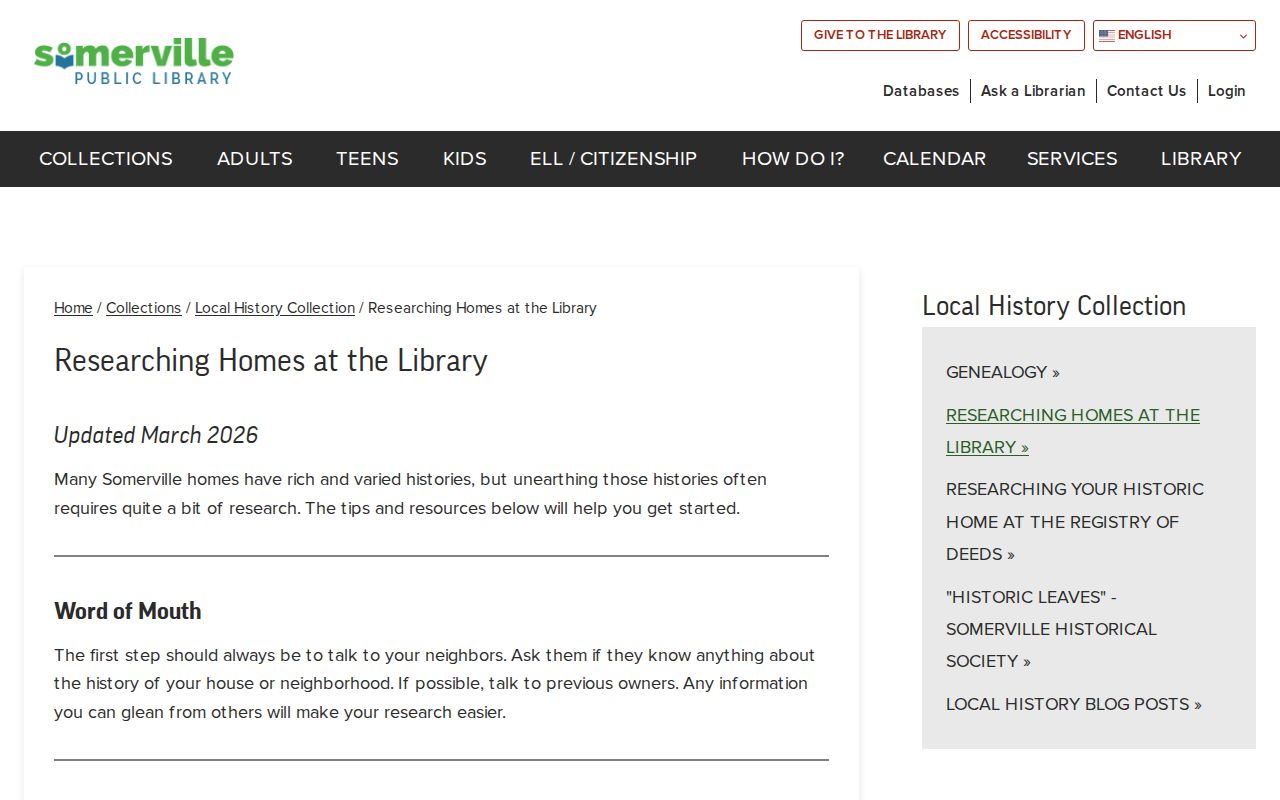
The guide is useful because it links a named address to permits, maps, probate, deeds, and local directories instead of relying on one record type.
Note: A permit records work on a structure or an applicant, so it should be paired with a deed or directory before making an occupancy claim.
Middlesex County Previous Residents Household Trail
Ownership is only half of an address history. The household layer comes from local directories, resident lists, census schedules, newspapers, and obituary indexes. Somerville's early directories are name organized through 1933, then ward, precinct, and address organized from 1939 onward. Cambridge offers a street-address cross-index after 1905. Winchester adds resident lists from 1901-2019 and directories from 1950-2012. Those documented formats help connect an address to a possible household without equating an owner with an occupant.
- Choose a directory or resident-list year that falls near the deed transfer or construction event.
- Search the name-oriented portion for earlier Somerville years, or use the later address arrangement and Cambridge cross-index where available.
- Record the town, address, occupation, household wording, page or image number, and every name spelling.
- Pair the result with the nearest public federal census, using the census as a decennial household snapshot.
- Check a local obituary index, newspaper, or probate docket when a move, death, or estate transfer may explain a change.
Somerville Public Library documents Federal Census of Middlesex County microfilm for 1800-1930, along with newspaper and obituary material. The collections themselves are described more fully in the Middlesex County city directories resource. Keep the directory year beside the census year rather than treating them as the same kind of evidence.
Middlesex County Address Record Maps
Maps and permits explain the physical side of an address. A Sanborn sheet can show a structure's footprint, materials, use, and later change. An atlas can show owner names, lots, street development, or boundaries. A permit can date construction, alteration, demolition, an inspection, or an occupancy certificate. None of these records alone proves who lived in a building, but each can clarify whether the same address and structure existed during a directory or deed interval.
Cambridge added a Permit Finder dataset and interactive dashboard in 2026 with address search, map display, permit-type filters, layered results, and detail views. The announcement does not state one full historic coverage date, so use the Cambridge Permit Finder announcement for its documented capabilities and ask the local records office about a particular older file. Somerville's permit and jacket years are documented separately in its house-history guide.
Middlesex County Trail Record Endpoints
When a deed chain reaches an estate, trustee, or "heirs of" wording, stop the ordinary seller-to-buyer loop. A probate file may identify a will, personal representative, heirs, inventory, estate address, or the transfer that explains a deed gap. Middlesex Probate and Family Court has North and South locations, while public docket access begins through MassCourts. Court documents and impounded material can have different access rules from the docket.
Obituary cards and local newspapers can supply a date, family name, former address, or funeral information that helps find the right probate record. Somerville maintains card and online obituary indexing for older material and holds the Somerville Journal from 1876 forward. Treat an obituary as a lead, then confirm a relationship or transfer through a probate, vital, or recorded-land source. This approach avoids turning a same-name mention into a firm identity conclusion.
Middlesex County Address Record Evidence
A careful house history separates four questions: who held recorded title, who may have occupied the address, what stood on the parcel, and what legal event changed the record. A deed answers the first question. A directory or census may address the second. A permit, atlas, or Sanborn sheet informs the third. Probate or an obituary may explain the fourth. Keeping those categories apart is the best guard against overclaiming from old records.
Lawful personal use. Use Middlesex County house-history material for family history, property curiosity, or personal research, and never use it to stalk, harass, track, or harm a living person.
Massachusetts also has protected addresses, confidential voter registration, and court impoundment rules. A missing name can reflect a restricted record, a file held by another custodian, or a simple catalog gap. Respect those limits and verify a factual conclusion with the office that holds the original record.
Note: A complete source note should preserve the town, record type, date, book and page or image number, and the reason the item supports the address history.